
Articles tend to portray AI in marketing in one of two ways. The first is a shining hero that will improve your efficiency and unlock success. The second is a big scary monster that will take your job and destroy humanity.
At Forge Apollo, we prefer to take a third approach: curiosity. How can AI help us, and how can we prepare for its potential positive and negative impacts on the industry?
Most coverage of AI in SEO takes the “big scary monster” approach and analyzes every facet of its capabilities. In this article, the SEO experts at Forge Apollo in Philadelphia are cutting through the noise to help you understand what you want to know–how will AI impact your brand’s traffic, and what can you do about it?
Key Takeaways
- AI search features are primarily disrupting informational searches so far, but transactional, commercial, and navigational searches have been more disrupted through 2025.
- More brands are starting to seeing the predicted traffic drops.
- Brands that largely depend on informational searches see the biggest drops.
- SEO is still alive and vital to keep your website visible in traditional search and new AI features, but needs to incorporate some new tactics.
- Brands should focus on visibility across all channels for increased brand awareness when buyers are ready to buy.
AI Search Features Impacting Search
Let’s start with a brief overview of the AI features impacting search results today.
AI Overviews
AI overviews are generative AI explanations that appear at the top of search results for select queries. They provide a summarized answer to the query with links to featured “sources” for each piece of information.

Google launched AI overviews in the United States on May 14th, 2024, and has slowly rolled them out further since then.
The appearance of AI Overviews in search results has been volatile since then. Several studies found that the number of search terms AI Overviews generate decreased after its initial rollout. SEMRush’s study found that in January 2025, AI Overviews appeared for 6.49% of searches. By July, that percentage rose to 25% before dropping to 15.69% in November.
The majority of these searches (57.1%) have “informational” intent rather than transactional, navigational, or commercial intent. In early 2025, Informational searches had a larger majority at 91%, but other types of searches have gained momentum. Informational intent means that users are looking for information on a topic rather than trying to find a specific website or product. Informational searches are usually top of the funnel in the awareness stage, while the other types are middle to bottom of the funnel.
The studies also found that about 60% of the time that AI Overviews appear, Featured Snippets also appear on the page. Featured Snippets include a small section of information from a page to provide an answer without clicking. In this example, an AI Overview appears directly above a featured snippet describing impact windows. We’ll cover why this is important to note later.

Google AI Mode
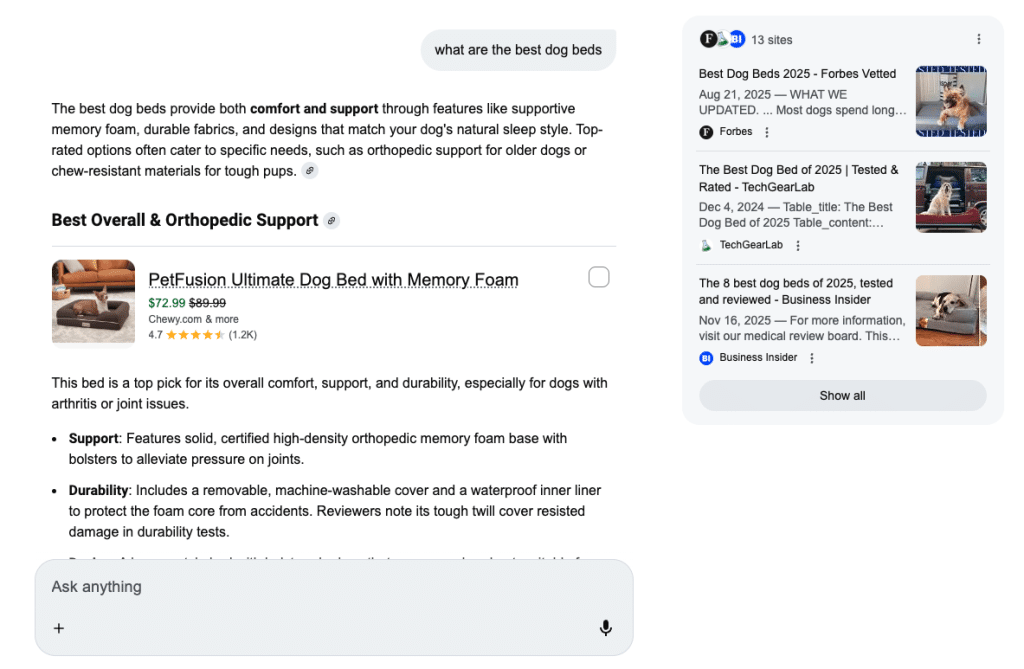
Google introduced AI Mode in Labs (their experimentation platform) on March 5, 2025, and rolled it out to everyone shortly after, on May 20th. Google AI mode essentially combines AI Overviews with an AI chat experience. When you make a search, you get a summarized answer (like an AI Overview). But you have the option to ask follow-up questions to dive deeper.
AI Search and Chats
Many AI chat experiences, like Chat GPT, Microsoft Copilot, and Google Gemini, are able to crawl the internet and include direct links in their responses.
For example, when asked about the best place to buy a dog bed online, Gemini and Copilot shared links to suggested articles and sources at the bottom.


Early data showed that traffic from ChatGPT to news publishers was minimal but growing–since then, it’s nearly doubled. We have seen some traffic for our clients coming from ChatGPT, but not nearly enough to consider it a primary traffic source yet. Data from Ahrefs from January – November 2025 shows that 41.75% of traffic to websites still comes from traditional search, while only 0.29% comes from AI search.
The Effect of AI on Traffic
When evaluating AI’s effect on organic traffic, two major factors must be considered: changes in search volume and changes in click-through rates.
Changes in Search Volume
As users grow more comfortable with AI chats, they may gravitate more toward them and less toward search engines for answers to their informational questions.
That could cause a decrease in organic and referral traffic, as fewer users turning to search engines for information means fewer website visits.
However, current data shows AI chats as a complement to search, not a replacement.
Changes in Click-Through Rate (CTR)
Changes in click-through rates also impact traffic. When users see a search results page, are they clicking through to the website?
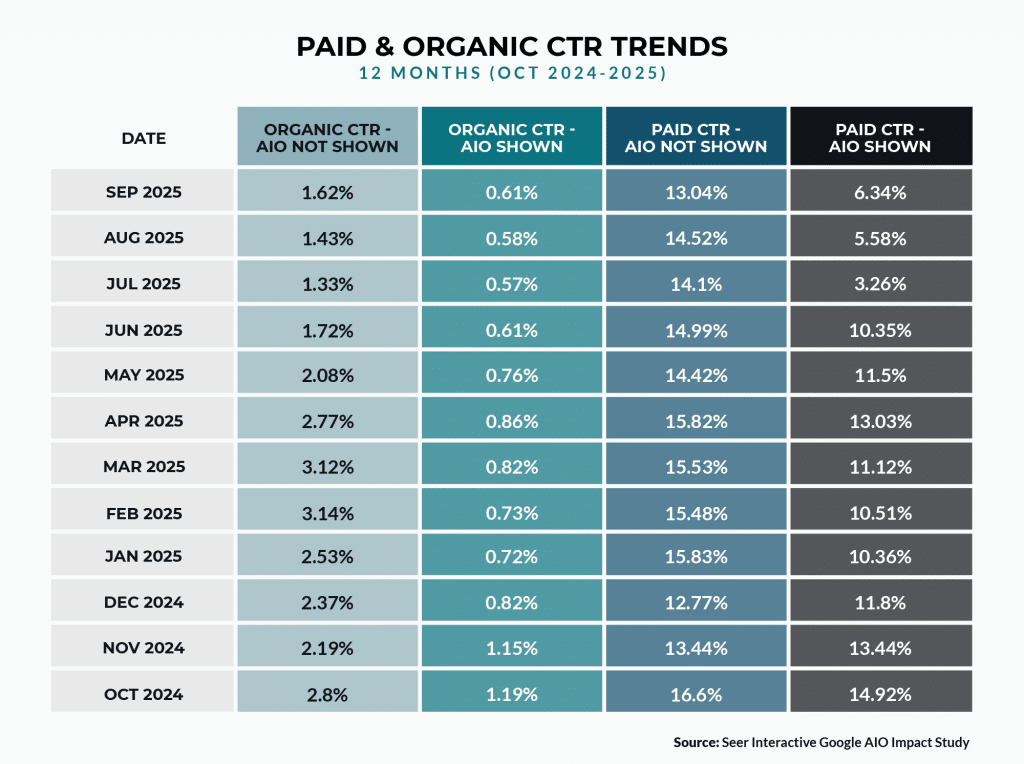
One study showed that when AI Overviews appeared on searches for a set of keywords with informational intent, CTR decreased significantly for both organic results and paid ads.
Early predictions said AI would cause a 30% drop in organic traffic. For a while, many brands didn’t see this come to pass. However, in the last few months, we’ve seen anecdotal industry evidence (and our own client performance) that this is starting to hit more sites. We’ll update this blog if any official studies come out about it.
Brands relying more on traffic from informational queries are more likely to see a hit. Chegg, an education technology company, is suing Google due to massive losses in traffic and revenue since the launch of AI Overviews. One SEO tool estimates that 86% of the keywords Chegg ranked for in the last two years have informational intent, which explains their massive drop.
Challenges in Measurement
Several challenges exist in trying to measure the true impact of AI search, including:
- Traffic Attribution – Google Analytics lumps AI Overview and AI Mode traffic together with traditional organic traffic, so there’s no way to break it out. Other LLMs, like ChatGPT, do come in as referral traffic, however.
- Presence in Citations – Whether it’s an AI Overview or a conversation with ChatGPT, different answers with different citations are presented for the same query.
How Will Drops in Traffic Caused by AI Affect Your Business?
It’s not time for most businesses to panic yet. The brands with the biggest threat to revenue are publishers that make money directly from traffic and ad views, like news websites or recipe blogs.
For non-publisher brands, Google claims that while they’re providing less traffic, the traffic they’re providing is more qualified (i.e., ready to purchase). While some in the industry are skeptical of this, we have seen organic conversions hold steady for our clients despite organic traffic drops. This is because while potential customers are finding their information elsewhere, they’re still coming to a brand when they’re ready to buy.
It’s vital to focus on brand visibility in AI, SEO, and other channels so that buyers continue to turn to you when they’re ready to purchase.
What to Do If You Notice Traffic Drops
A massive organic traffic drop may not be caused by AI. Traffic drops can happen for various reasons, from algorithm updates to technical errors. If your brand experiences a significant decrease in organic traffic, work with an experienced SEO agency to investigate it.
Adjusting Your Strategy for AI
AI may land somewhere between a shining hero and a terrifying monster, but one thing is sure–it’s not going anywhere. It can be an opportunity if you optimize properly.
Here are some tips to optimize your brand for the AI era.
- Stay True to Technical SEO Practices – Organic traffic may decrease, but it’s not disappearing. Both search engines and Large Language Models (LLMs) read your website similarly. Classic SEO best practices, like a well-built website, are still a must.
- Encourage Brand Mentions – AI chats offer a whole new brand discovery opportunity. Try to encourage more positive mentions of your brand online so LLMs are more aware of you.
- Monitor Your Brand’s Performance – Keep an eye on your performance to evaluate necessary strategy changes. Use a tool like SEMRush’s Organic Research to gauge how much of your traffic comes from searches with informational intent. HubSpot’s AEO Grader can also provide insight into your visibility within LLMs.
- Highlight Your First-Hand Perspective – Your unique perspective will always be something AI can’t replicate. Draw on that experience when creating content for your website.
- Stay Tuned In – AI search features are rapidly developing, and their impact on search now might not remain the same in a few months.
- Diversify – If you rely solely on organic traffic for leads, consider adding in some different avenues.
- Be Visible in More Places – Creating more content across the web, like podcasts or social media content, can diversify your visibility so that potential leads are more likely to be aware of your brand. It can also help AI engines be more aware of your brand to recommend you in more responses.
SEO Is Still Alive! Work With an Expert
While AI features do change the landscape of organic search and traffic, they aren’t killing it. Proper SEO techniques are still vital to keep your brand visible. In fact, new techniques, sometimes called GEO (Generative Engine Optimization) or AEO (Answer Engine Optimization), may be necessary.
Now is the time to work with an experienced agency that knows how to analyze and optimize your brand’s online visibility and performance. Forge Apollo can help. We offer SEO marketing based in Philadelphia and stay up to date on all things AI and marketing, so you don’t have to. Contact us today for help with your SEO and AI strategy.