What do marketers need to know to execute effective strategies in 2026? Today, we’re sharing the digital marketing statistics you should know to shape your strategy. The experts at our digital marketing company selected each of these statistics from primary sources and studies or surveys, so they’re real, fresh, and relevant.
Let’s dive in.
Marketing Channel Statistics
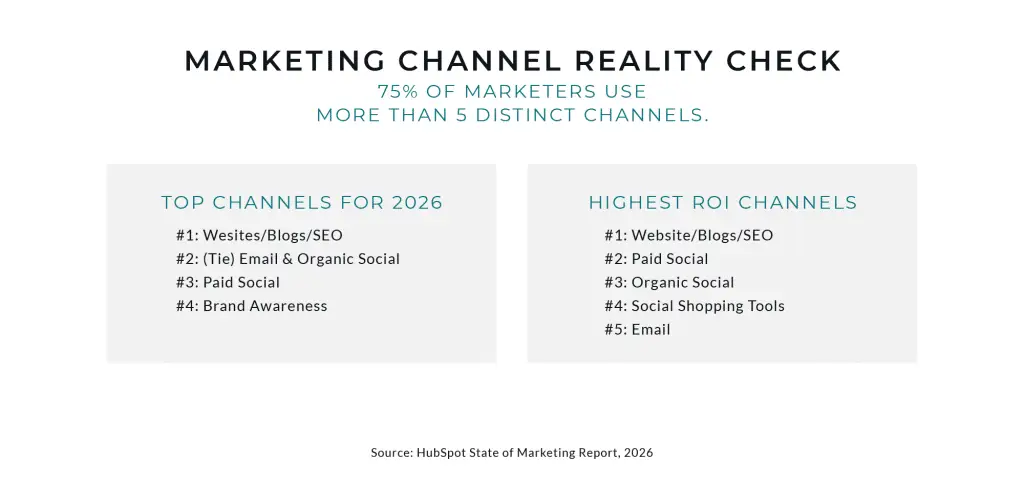
These statistics, all from HubSpot’s 2026 State of Marketing Report, show which channels marketers value today.
- 75% of marketers use more than five distinct channels.
- Websites, blogs, and SEO are the top channels for marketers in 2026, while Email marketing and organic social media tie for second place, with paid social media at a close third.
- Marketers report getting the most ROI from the following channels, in order: Website/Blog/SEO, Paid Social Media Content, Organic Social Media Content, Social Media Shopping Tools, and Email Marketing.
- 45% of marketers use 10–20% of their budget for testing new channels.
- 71% of marketers say that AI makes it easier to create more content across channels, but 53% say that it’s saturated the market so much that differentiating their content is a struggle.
- 63% of marketers say they need human-centered, unique content to make an impact.
The Takeaway
These digital marketing industry statistics prove that marketers need to spread their strategy across channels. When comparing usage to ROI, websites/blogs/SEO remain a stronghold for brands despite the impact of AI.
Other traditional channels, like email and social media, continue to hold strength. As user behavior changes, it’s also vital to dedicate budget for experimentation to keep up.
But simply pumping out AI-generated content across channels isn’t enough because the barrier to entry is so low. Brands need to lean on their real, human experiences to stand out.
Websites, Blog, and SEO Statistics
According to HubSpot’s report, Websites/blogs/SEO were the biggest driver of ROI for marketers in 2025. So, let’s review the statistics.
Traffic & SEO Strategy
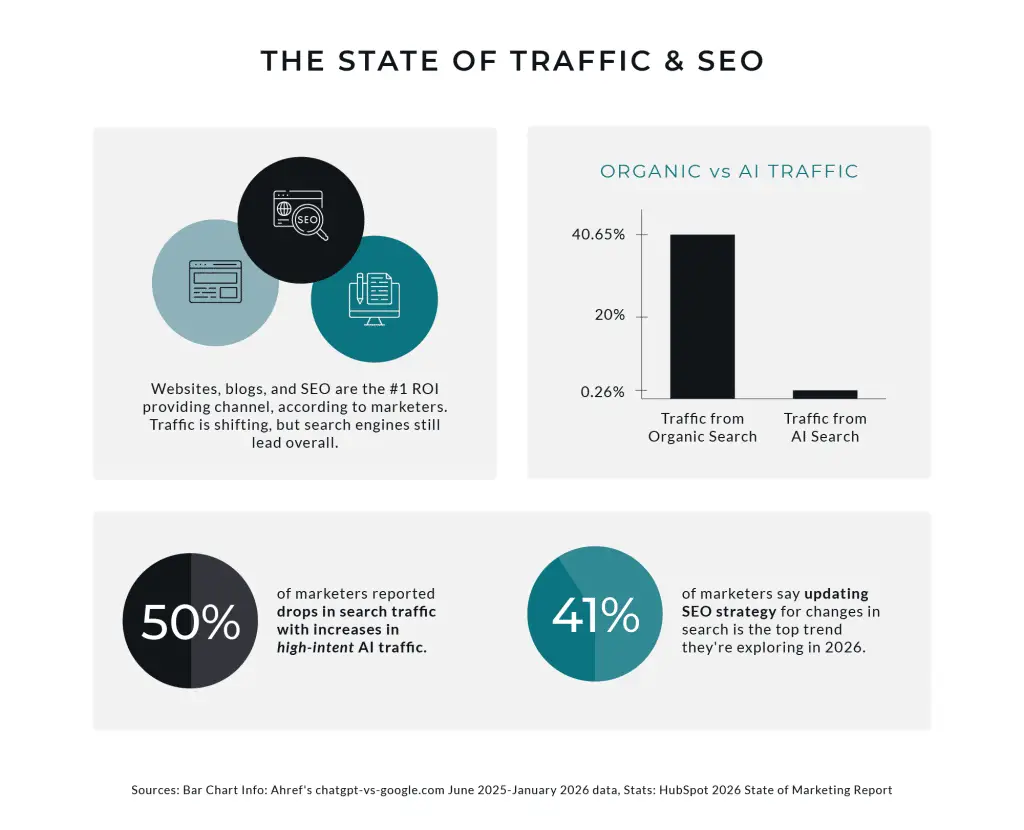
- 40.65% of website traffic still comes from organic search, while only 0.26% comes from AI referral traffic (Ahrefs).
- 50% of marketers have reported drops in search traffic with increases in AI traffic, but the AI traffic has higher intent (HubSpot State of Marketing Report, 2026).
- 41% of marketers say that updating SEO strategy for changes in search is the top trend they’re exploring in 2026 (HubSpot State of Marketing Report, 2026).
The Takeaway
AI is affecting search traffic, but it isn’t making it disappear. It’s important to include both SEO and AEO (AI engine optimization) in your strategy. Plus, your user experience should be good enough to convert users visiting from AI engines with higher intent.
Blogging

- Blogging is tied for the second most common media format companies use in their content strategy (behind short-form video, tied with long-form video) (HubSpot State of Marketing Report, 2026).
- The average blog post is 1,333 words, down for the second year in a row, reflecting a trend toward more targeted content over lengthy guides (Orbit Media).
- Blogs that publish 3+ times a month are more likely to have strong results (Orbit Media).
- Only 45% of bloggers include contributor quotes, and only 26% include video. Using either element makes your content more likely to have strong marketing results (Orbit Media).
- Marketers who include 4+ visuals in their blogs are more likely to support strong results (Orbit Media).
- 49% of content marketers published original research in 2025, up from 2024 (Orbit Media).
The Takeaway
Blogging is an effective strategy, especially when you put in the effort to post consistent, high-quality content. Readers want to see research, expert opinions, and visuals.
Use of AI in Blogging
- Writers who use AI for support tasks, such as creating visuals, brainstorming topic ideas, or writing headlines, are more likely to report strong results (Orbit Media Survey).
- Writers who use AI to write complete drafts are the least likely to report strong performance (Orbit Media Survey).
- Almost 94% of marketers plan to use AI to help with content creation in 2026 (HubSpot State of Marketing Report, 2026).
The Takeaway
Blog strategists and writers should use AI to support the process, like for outlining or visual creation. However, AI shouldn’t replace the bulk of the writing itself.
Email Marketing Statistics
According to HubSpot, email marketing is the second-most-used channel (tied with organic social media) and has the fifth-highest ROI. Let’s explore what marketers should know about it with these stats.
General Email Usage
- There are 4.59 billion email users worldwide (Statista).
- Tuesday is generally the best day of the week to send emails (Statista).
- About 75% of marketers maintained or increased their email marketing investment in 2026 (HubSpot State of Marketing Report, 2026).
- 75% of online adults check their email monthly (DataReportal).
- 33% of consumers mark emails for deletion by scanning who they’re from, while 31% base it on the subject line. 43% often unsubscribe from brand emails (AirShip).
The Takeaway
Email is still widely used in 2026, and it pays to optimize your subject lines and your overall relationship with recipients so they’re less likely to delete your content based on your name alone.
Email Performance
- The average open rate across all industries is 37.93% for campaigns and 48.75% for automated email flows (Klaviyo)
- The average click-through rate (CTR) across all industries is 1.29% for campaigns and 4.67% for automated email flows (Klaviyo)
- The average bounce rate across all industries is 2.48% (WebFX)
- The average unsubscribe rate across all industries is 0.22% (Mailchimp)
The Takeaway
The most effective performance benchmarks will be specific to your industry, but there are some general ones to start with.
Personalization
- Segmenting emails can increase opens by 30% and clickthroughs by 50% (HubSpot State of Marketing Report, 2023)
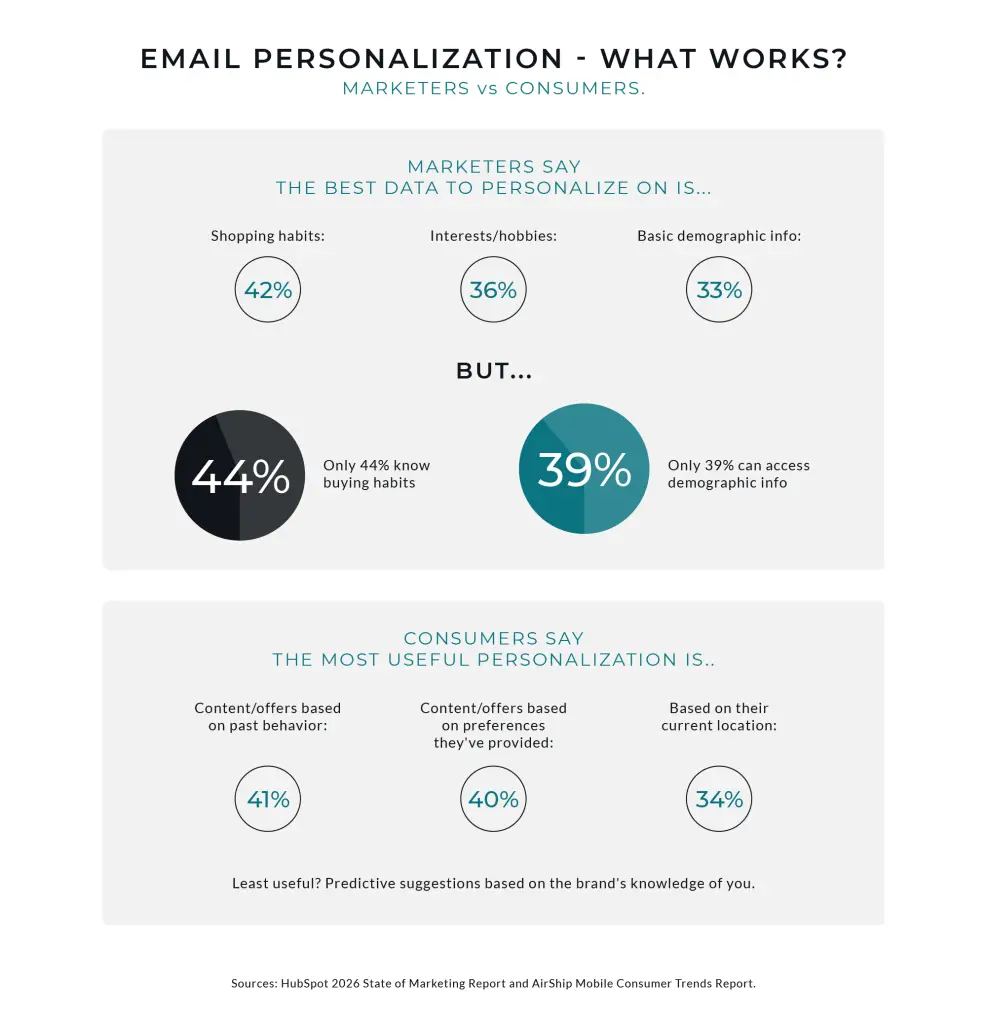
- According to marketers, the best data to base personalization on is:
- Shopping habits (42%)
- Interests and hobbies (36%)
- Basic demographic information (33%)
- However, only 44% of marketers know their customers’ buying habits, and only 39% can access demographic information (HubSpot 2026 State of Marketing Report).
- According to consumers, the types of personalization they find the most useful are:
- Content and offers based on past behavior (41%)
- Preferences they supplied to the brand (40%)
- Those targeted to their current location (34%)
- The least useful was “predictive suggestions based on everything the brand knows about you.” (AirShip)
The Takeaway
Consumers respond well to personalization in email marketing. However, they want the personalization to come from data they voluntarily shared with the brand, such as past purchases. Marketers should focus on effective ways to gather consumer data, such as using a CRM with an integrated email platform, like HubSpot.
Social Media Marketing Statistics
According to HubSpot, paid and organic social media deliver the second and third-highest ROIs among channels. 90.13% of people in the U.S. use social media, with Facebook as the most used network (Statista), so it’s no surprise that social is a popular channel.
89% of brands worked with influencers or content creators in 2025. That’s up from 50% the year prior. Brands find the most success with “micro-sized” influencers, or those with between 10K to 100K followers (HubSpot State of Marketing Report, 2026).
Short-Form Video
- Marketers’ top content format for 2026 is short-form video, with 104% more marketers naming it as their highest-ROI content format in 2026 than in 2024 (HubSpot State of Marketing Report, 2026).
- Instagram has 2 billion monthly active users (Statista), spending 50% of their in-app time watching Reels. (Meta Earnings Call).
- TikTok has an estimated 1.59 billion global users, with 135 million of them in the United States (Statista).
- YouTube Shorts gets 200 billion daily views (Alphabet).
The Takeaway
Brands should be on social media and collaborating with creators or influencers. If you’ve never done this before, this is a great use of some experimentation funds. As far as format? Short-form videos, like Reels or TikToks, are the way to go in 2026.
Paid Advertising
According to marketers in HubSpot’s state of marketing report, paid social media content was the second-highest ROI providing marketing channel, and 12% of marketers reported search and display advertising as providing the most ROI.
- 25% of U.S. consumers use ad blockers on the internet (Statista).
- 26% of marketers report personalization being most effective on paid social media ads vs other marketing channels, while 14% say it’s most effective on search and display ads (HubSpot State of Marketing Report, 2026).
The Takeaway
Although some consumers will go to lengths to avoid online ads, both social and search/display remain effective channels. Personalization is an opportunity to make your ads more valuable to consumers, as long as it’s helpful rather than “creepy,” as we saw with email marketing.
The Ultimate Takeaway
These digital marketing industry statistics paint a picture: while traditional channels remain strong, it’s time to mix in new formats, tactics, and experimentation. Forge Apollo, an experienced digital marketing agency serving Chester County, PA, and surrounding areas, is here to help you adjust your strategy for modern times. Reach out today to plan your strategy.