
Clearly defining goals makes it easier to achieve them. In fact, one study found that you’re 33% more likely to reach a goal if you document it. But not every goal is created equal. SMART goals are a framework for creating objectives that are Specific, Measurable, Achievable, Relevant, and Timely.
At Forge Apollo, we help businesses develop SMART goals and track progress to ensure marketing efforts produce a strong ROI. Let’s dive deeper into SMART goals and why they should be a part of your marketing strategy.
What Are SMART Goals?
The SMART approach is a framework for creating actionable goals. Each of the five letters in this mnemonic device represents a specific standard that your goal needs to meet to succeed. In short, SMART goals are Specific, Measurable, Achievable, Relevant, and Timely. Forge Apollo uses this framework to create goals for our clients and our team.
Specific
Specify what you want to accomplish, what you’ll need to accomplish it, and who needs to be involved. Outlining these primary elements will make it easier to map out the steps necessary to achieve your goal.
Measurable
How will you know if you’ve accomplished any of your goals? Goals have to be measurable. Identify one measurable aspect of your goal and how you will measure it.
Achievable
Goals should be challenging but achievable. Try to find a healthy medium between optimism and realism when defining goals.
Relevant
Always consider your brand values and long-term efforts when generating goals. Make sure you understand how this particular goal contributes to future business goals.
Timely
Being sure your goal is time-bound doesn’t necessarily mean setting a strict time limit for your task. Ensuring your goal is timely means being aware of approximately how much time it will take to achieve it and selecting an appropriate time frame.
How to Write a SMART Goal
Let’s walk through how Forge Apollo creates SMART goals step by step.
1. Define Your General Objective
Before you get too deep into specifics, what’s your general objective? For example, our client may want to increase brand engagement. Defining your objective early keeps your goal in line with the larger business objectives.
2. Think “How” to Get Specific
Research a specific tactic to try that will support your general objective. For example, we might suggest our client write high-quality thought leadership blogs to drive engagement.
3. Choose Your Metrics
Define the metrics you’ll use to measure success against your goals, and the threshold you’re aiming to reach. In our example, we might suggest increasing the blog engagement rate by 15%.
4. Check Your History and Resources
Making a goal too hard will set you up for failure. Consider your past performance and the resources you have available to help you achieve your goal. In our example, we would look at how engagement rates have improved in the past with new content and ensure we have the resources to write high-quality content.
5. Choose a Time Frame
How long do you need to achieve this goal? A week? Six months? A year? Setting a definitive end date for the goal gives you the opportunity to check in on progress and refine your efforts for future goals.
SMART Goal Example
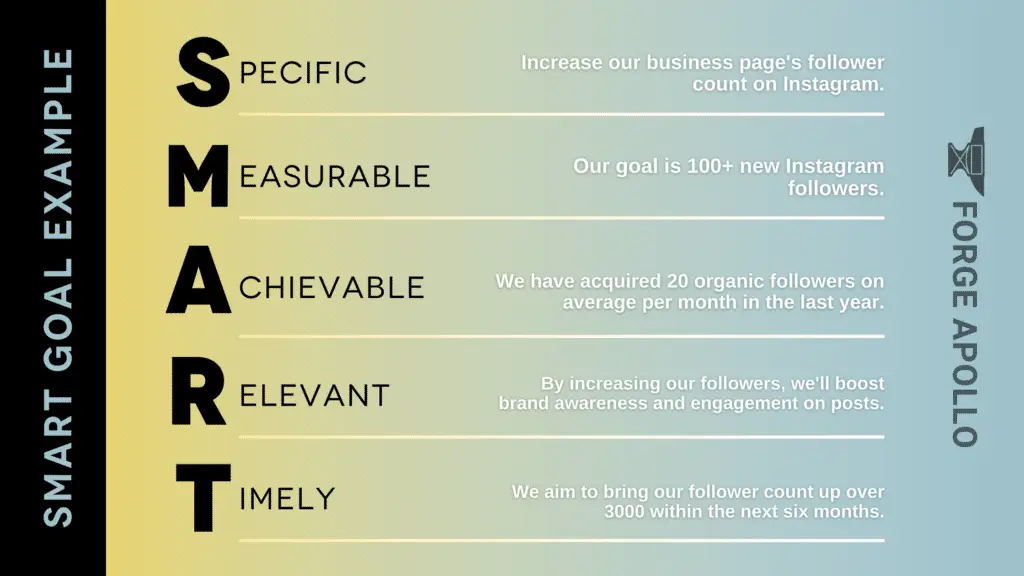
Here is an example of a SMART goal Forge Apollo made for ourselves:
- Specific – Increase our business page’s follower count on Instagram
- Measurable – Our goal is 100+ new Instagram followers
- Achievable – We have acquired an average of 20 organic followers per month over the last year.
- Relevant – By increasing our followers, we’ll boost brand awareness and engagement on posts.
- Timely – We aim to bring our follower count u over 3000 within the next six months.
Why Do I Need SMART Goals?
SMART goals provide a framework for thinking through and documenting your objectives. According to research, marketers are 376% more likely to report success if they’ve documented their goals.
The SMART framework sets boundaries within a business while measuring growth and progress. This is because it provides the crucial factors your team needs.
- Clarity – Your team understands exactly what they’re trying to achieve, so they can plan how to get there.
- Motivation – Documenting and planning your goals provides motivation to work towards them. For example, a Dominican University of California study showed that 70% of participants who shared their goals with someone successfully achieved their goals, compared to only 35% who kept their goals to themselves.
- Ownership – Assigning SMART goals to specific team members fosters a sense of ownership over their work, which can lead to increased productivity.
- Priorities – By implementing SMART goals, your team knows what efforts to prioritize when workloads get high.
—> FREE Hubspot Template for Creating SMART Goals <—
How Can Our Philadelphia Marketing Agency Help?
Forge Apollo uses SMART goals to increase performance for our team and clients. Proper prioritization and goal-setting are the best ways to guarantee success within your business, and we’re eager to help get you there. We specialize in marketing strategies and production techniques that drive your company to victory, regardless of individual objectives. Contact our Philadelphia marketing agency today for a professional, personalized initiative to help you level up your brand!